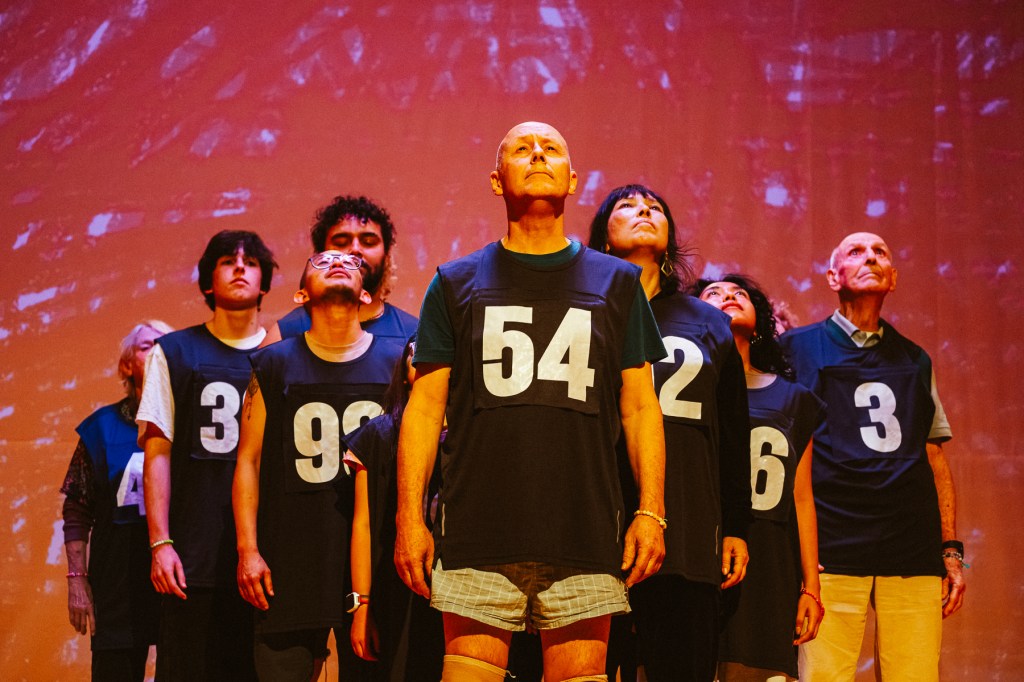
When is the prime of life? Has that time passed, or perhaps, you hope it’s still to come? Prime Time, directed by Penny Baron with Assistant Director Carolyn Hanna, is a unique production, featuring a cast ranging in age from 5 to 93, and uses an engaging amalgam of interview and movement to ask these questions and more, in order to explore how we all feel about being different ages.
The show invites some audience interaction which starts before entering the theatre; there is an opportunity to share our own perspectives by writing down the answer to one of two questions. A/ What is the best thing about being the age you are? OR B/ What is a challenging thing about being the age you are? Even deciding which question to answer is a telling one – choosing to take a positive angle, or does the mind turn to express a struggle? Answers are collected before the performance with select ones read out loud onstage later. The participation continues with cast members doing vox pops of the audience once seated. What age are you today? What age do you feel? Next there’s a game of pass the parcel, with the final recipient answering another question enclosed.
The scene is set quickly as one of fun. Choreographic consultant Michelle Heaven gets our performers moving; games are played onstage, and performers pair up to dance together to much mirth, or play a game of statues (holding still as the music stops, if you move you’re out!). Sound design by Michael Havir features thoughts of ageing through audio projection and matching live text shown on a screen, while lighting, set and costume by Jenny Hector is very colourful. The combination provokes thoughts of whether playing is just for the young. When do we stop playing games or moving for the enjoyment, not just for exercise?
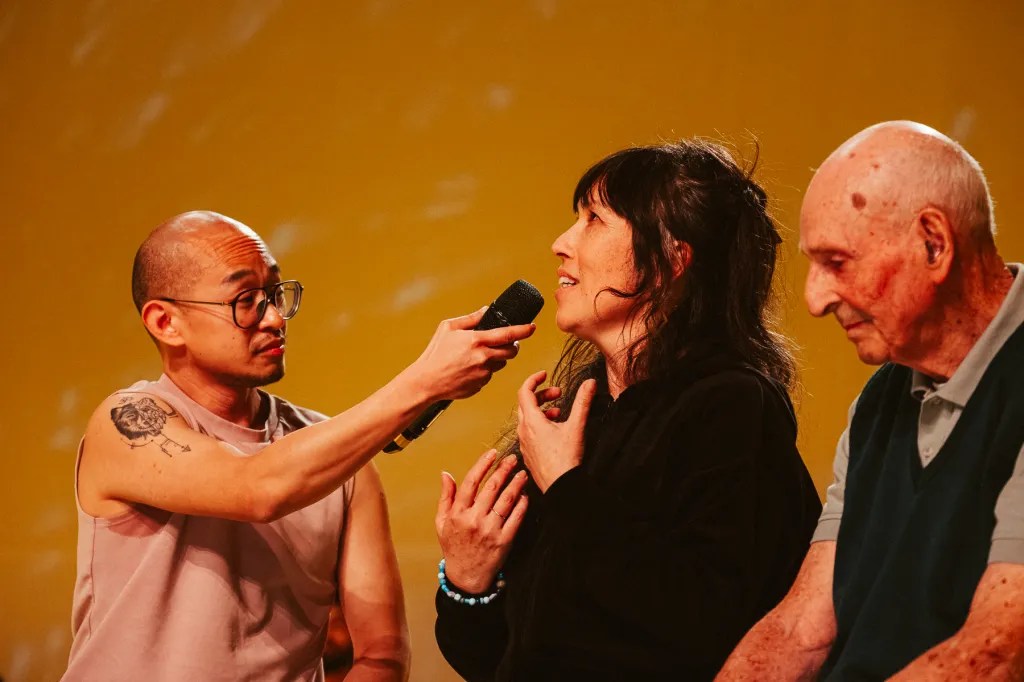
The audience walks in to take their seats, to find the performers already on stage. This had an immediately inviting effect, there’s just more humans there, blurring the line between reality and performance. Indeed, even without any prior knowledge of this production, it becomes apparent quite quickly that our cast is not quite acting, but sharing their own personal views. They sometimes reference people in their lives who are sitting in the audience. This is combined with the audio of thoughts shared from other interviews with people not present (recorded at a community hub during the preparation for the play). Many of these are delightful and I wanted to see those who delivered them, or hear more. However, while so many short snippets was perhaps a sound design choice, the cumulative effect of these disjointed musings was a touch over-done.
The cast is not only age-diverse, featuring a 69 year old man who loves to dance, and a 14 year old girl with ASD (Autism spectrum disorder) and a special interest in Tarantino films. There are not one but two cast members who are 93! (Kudos for the physical challenges this show may have presented – and of course their performances are particularly poignant). There is a trans man in the current production, and previous incarnations have featured a performer missing a leg and a wheelchair user. This inclusivity is an asset as it asks us to consider how factors or events – whether visible or invisible – may affect the perspective of someone towards their own life stages. Although the cynic in me did question whether it was truly diverse, being so reflective of the inner-west Melbourne community in which we were sitting. There wasn’t a 45 year old CEO in the mix. What might this production have looked like if it was produced in the eastern suburbs, or a rural town?
As the show progresses, it delivers a real sense of the expectant hope/fear and looking forward of the more youthful, while there is a growing acceptance and embracing of the moment that comes with age. One commonality is how every cast member speaks so naturally about their experiences and views. To the point it’s actually not clear whether the play is scripted or improvised, it feels that authentic and fresh in delivery. If these lines have been delivered multiple times before, these people have done an incredible job of removing that impression. An array of wisdom is shared, not only on age, but culture, families, bodies, and choices. The things we can control versus the things we can’t. Special mention to performer Clovis Mwamba who delivers a particularly eloquent and profound speech about death and ancestors. It’s impossible not to be introspective during this production, and some lines begged to written down and remembered; life is all about moving towards something unknown, but something hopeful.
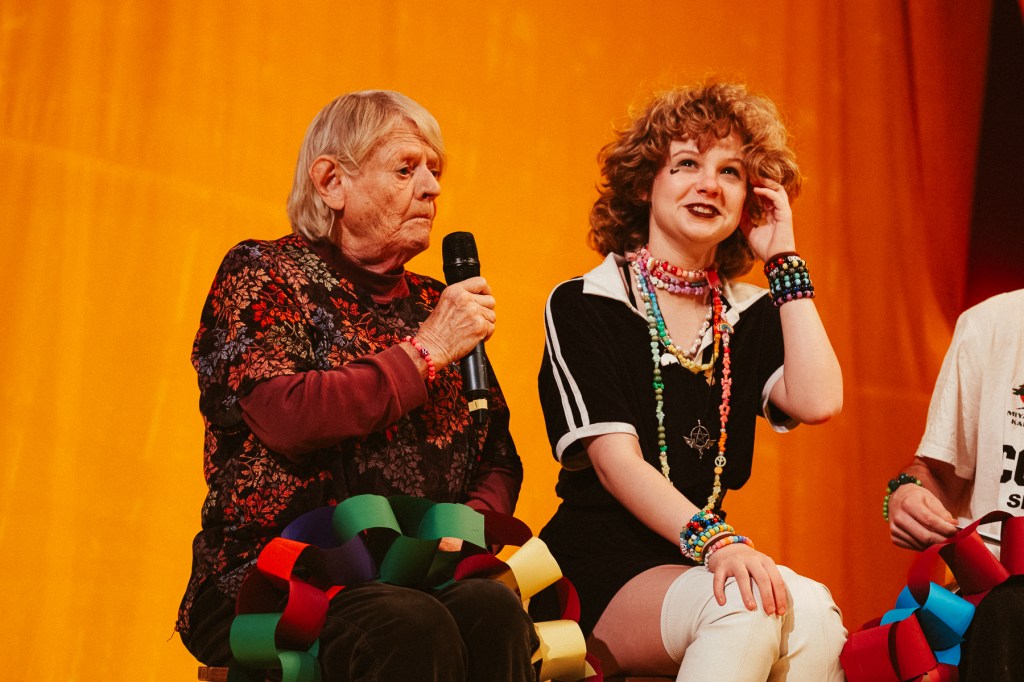
There is much levity in the delivery of dialogue even though the experiences shared of ageing also include loss or tragedy. This is enhanced by a very colourful set – a very high stage completely surrounded in a bright, sunshine yellow. A light bulb chandelier switches through a kaleidoscope of colour and a daisy chain of colourful paper is constructed on stage. Life is colour, variety and delightful.
There are real moments of sadness, when there is a realisation of while we’re all in this together, we will all have times when we feel quite alone. But these are brief. The overwhelming effect of Prime Time is one of community, of openness, of vulnerability being strength, and of the joy of shared experience. It vividly communicates that even when we are faced with a seemingly completely different person, in age or experience, you can hear a story that you can relate to. We only have to ask, and to listen.
3.5 stars
Playing as part of the Melbourne Fringe Festival, Prime Time by Born in a Taxi ran at The Substation, Newport, Melbourne from 14-17 October 2026.
Run Time: 70 minutes
For more info visit Melbourne Fringe


Leave a Reply