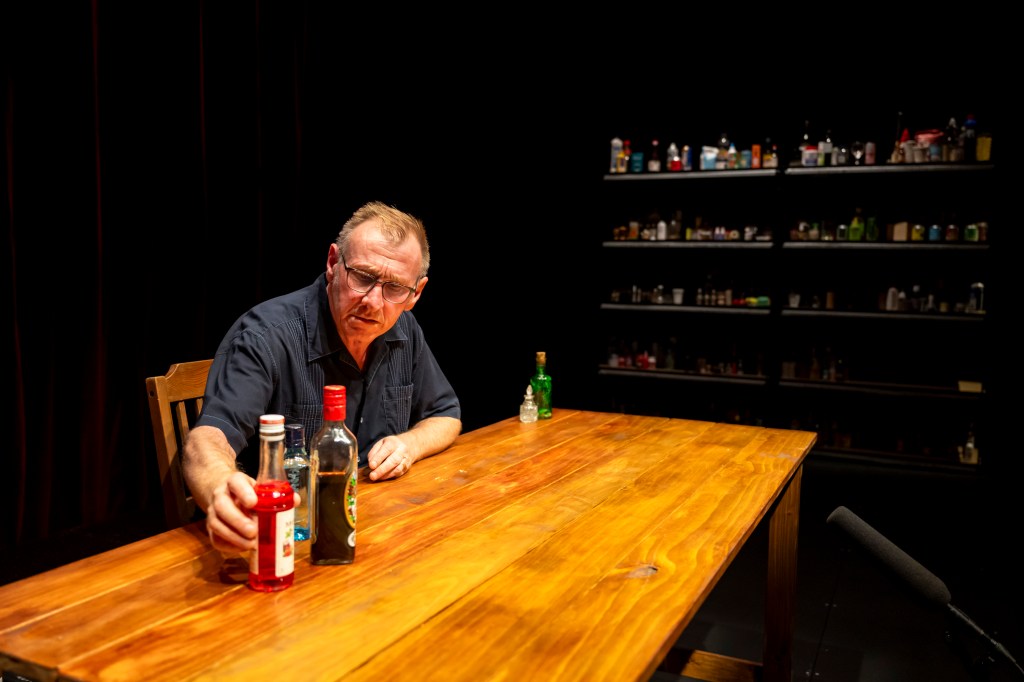
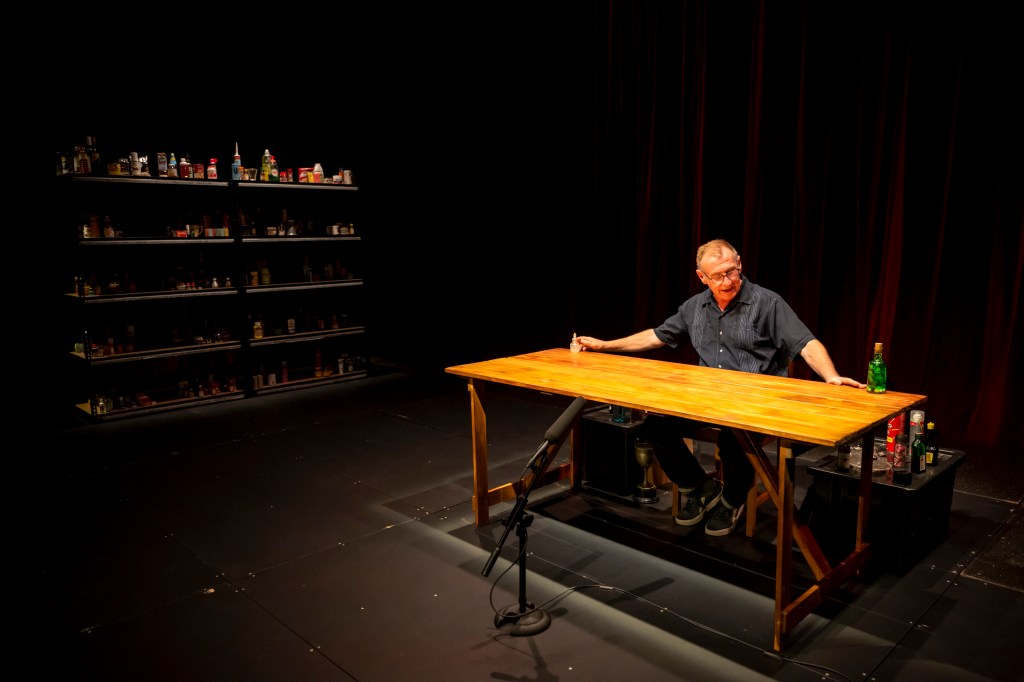
Entering the Sydney Opera House Studio, you could be forgiven for thinking you had forgotten your shopping trolley faced with two five-tiered shelves either side of a wooden table. Stacked to the brim with an array of kitchen staples, condiments and household objects, here you could find anything for any occasion. Baked beans. Shoe polish. Vegemite. Wine.
As the name suggests, Table Top Shakespeare turns 20 of the Bard’s masterpieces into ‘tabletop’ performances using household staples. One actor takes a play, stripping back the Shakespearean prose and translating it into everyday language.
Brought to Sydney for the first time by acclaimed UK experiential theatre company Forced Entertainment and directed by Tim Etchells, the charm of the production comes from the casting process, which is carefully considered, cleverly curated, intentional and, above all, symbolic. How could you not be tickled by a coffee pod being called an idiot or an orange being unlucky in love?
The clever use of household objects extends to the set. With design by Richard Lowdon and sound and lighting by Jim Harrison, two black storage boxes have been strategically placed behind the table, either side of a single chair with a selection of items at the ready. A microphone is set low at table height. Apart from the shelving, there is no other set. The back of the stage is lined with red velvet curtains, adding a cosiness to the warmly-lit theatre.
Breaking down the barriers of a 400-year-old language unlocks the magic of William Shakespeare, which, underneath it all, is his art of storytelling.
The Merchant of Venice
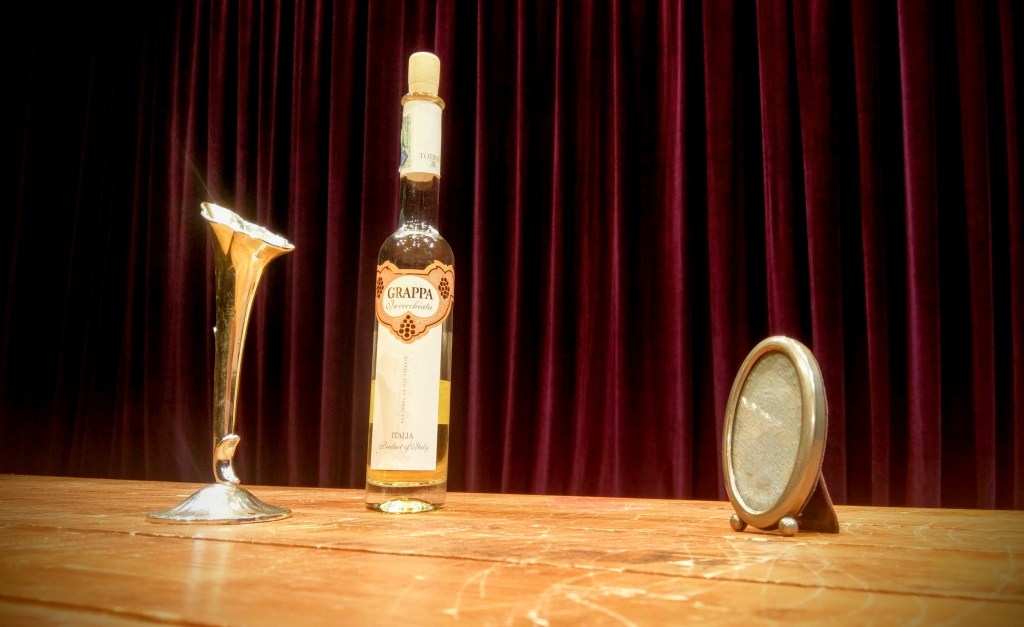
Company player, Claire Marshall, appears dressed in a black shirt dress and sits at the table. She introduces our protagonist: the wealthy Venetian merchant, Antonio, who is to be played by a tall bottle of Grappa.
He is joined by his silver-candelabra-friend, Bessanio, who asks for a loan to pursue the fair Portia of Belmont, a rose essence bottle. Antonio is confident he can secure the funds from Shylock, a Jewish moneylender. Represented by a small, empty photoframe, Shylock seeks revenge on Antonio, who has treated him poorly and sets “a pound of flesh” as bond for the loan. Out of arrogance and pride, Antonio agrees.
As the narrator, Claire guides the audience through the twisting plotlines of deception and revenge. She speaks directly, almost as if it were a casual conversation between friends having coffee and the Venetians are the latest gossip.
Her dry sense of humour keeps the atmosphere light, highlighting the many ironies of the “puppets” along the way who include, but are not limited to, jars of French Dijon and Colman’s English mustard, Italian tinned tomatoes, a stout bottle of German alcohol, and crystal vases to represent Venetian royalty.
Yet, despite The Merchant of Venice being one of Shakespeare’s most frequently studied and complex plays, there are no powerful speeches to be made, no desperate pleas for life or mercy, nor controversial themes to debate. Instead, what you’re left with are the bare essentials of this tragicomedy where all’s well that ends well, at least for the gold and silver ornaments, that is.
A Midsummer Night’s Dream
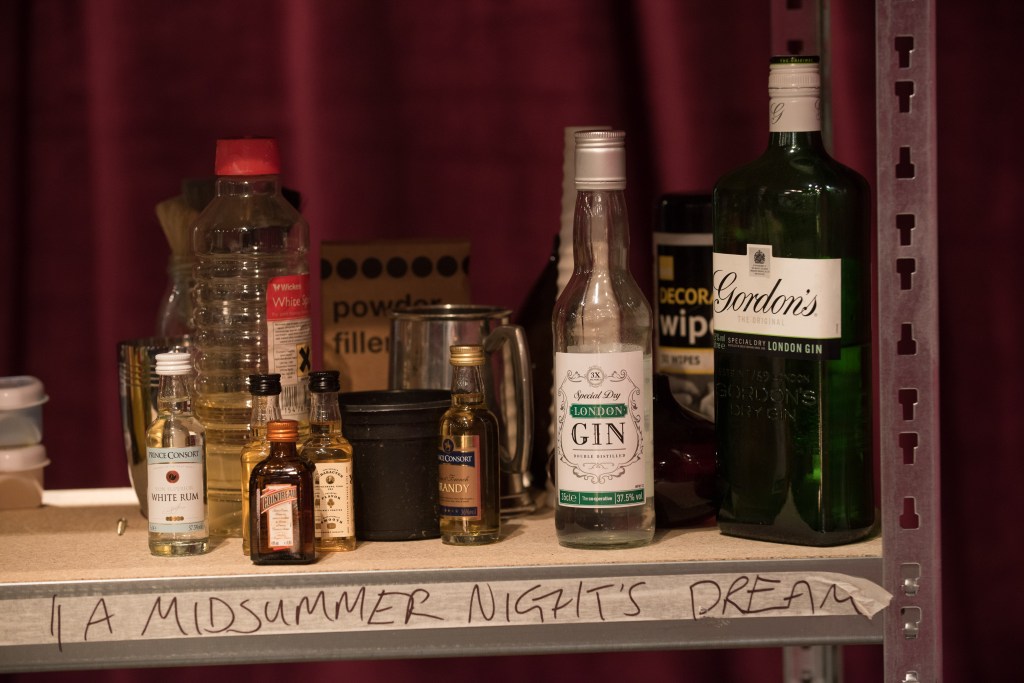
A reset stage sees Robin Arthur take his seat at the table top where he pulls out a silver beer stein. Performances at the Sydney Opera House are thirsty work after all but no, he is presenting Theseus, the Duke of Athens. Alongside him is a silver beaker, his wife-to-be and Amazon Queen, Hippolyta.
But standing in the way of their wedding day is the civil issue of Hermia. Cast by a small white ceramic cup, she will not wed the man of her father’s choosing. Instead, she is in love with Lysander, a towering, white and well-matched ceramic vessel.
Unrequited love takes the form of Helena, a tall brown vase who pathetically seeks the affections of Demetrius – a brown portly vase and Lysander’s competition.
All four end up in the forest but the “spirits” of this enchanted wood have troubles of their own.
Taking the form of large gin bottles are Oberon and Titania, the King and Queen of the Fairies. Jealous of his wife’s new page boy, Oberon, sends his mischievous servant Puck, a minibar-sized bottle of Cointreau, to trick her into falling in love with the next creature she sees. Chaos ensues.
A Midsummer Night’s Dream, as a comedy, lends itself well to this experimental theatre and it’s clear the narrator, Robin, has fun with the performance.
The simple act of attempting to tame the rotundness of his players as he lays them down to rest is, in itself, comic relief at its finest. His flair and style is reminiscent of a Monty Python skit that keeps the audience chuckling right through the production.
But is it still Shakespeare if there is no iambic pentameter? After all, “a rose by any other name would smell as sweet”. The concept is as intriguing as it is necessary for the modern era as it makes the Bard’s works accessible. For while the themes explored by this legendary playwright may be timeless, they are at risk of becoming reduced to AI summaries or lost to future generations.
If you enjoy the abstract or the unconventional, being introduced to these iconic plays for the first time, or simply wish to better understand the Bard’s works, Table Top Shakespeare is the perfect night out. Entertaining and refreshing, it unlocks his 400-year-old masterpieces for a new generation.
3.5 stars
Presented by Forced Entertainment Table Top Shakespeare is playing at the Studio, Sydney Opera House in Sydney from 22 until 27 September 2026.
Run Time: 140 minutes, including a 20 minute interval
For further information visit Sydney Opera House


Leave a Reply