
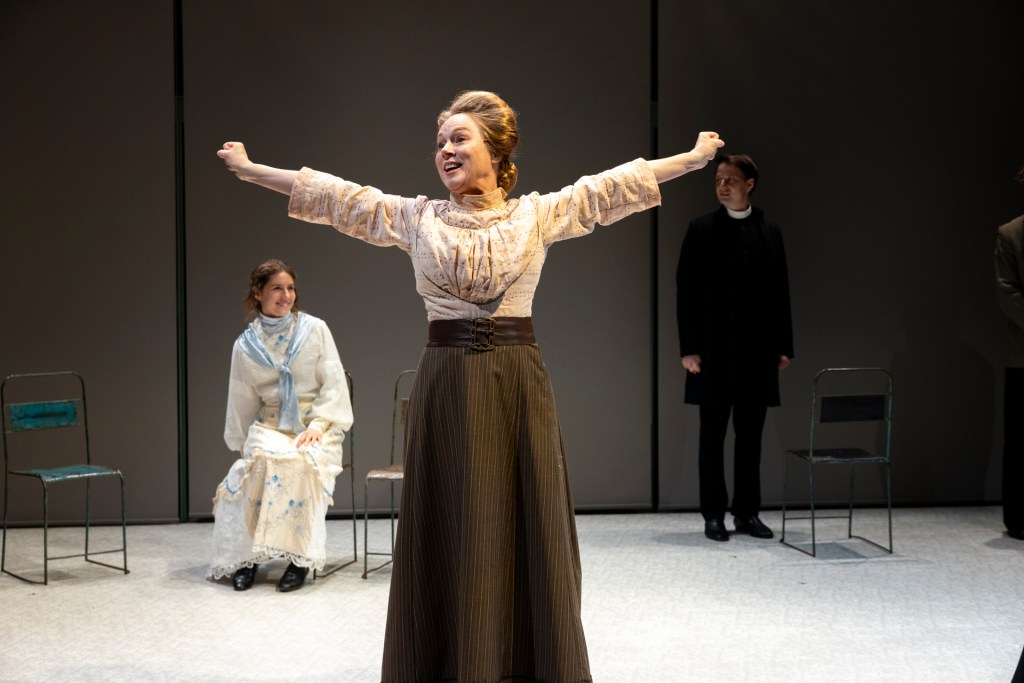
A Room with a View is a love story set in 1907, when status and standing were of great importance and love was often resisted.
Based on E.M. Forster’s novel and newly adapted by Grace Chapple, the story was also made into a film in 1985, starring a young Helena Bonham Carter.
The period romance captures an era when young people are trying to think and live in a society that wants to make all the decisions for them. Chapple shares that despite the difference between the eras, A Room with a View tells a story that still resonates today: “learning to think for yourself in a world that is really trying to tell you how to think.”
Directed by Hannah Goodwin, the story is told through first- and third-person narration, with multiple characters taking on the role of narrator, a technique that also brings a comedic edge to the production.
The narrative centres on a young English girl Lucy Honeychurch who travels to Italy with her chaperone, where she meets a number of interesting characters, in particular George Emerson, to whom she is passionately drawn but determined to resist.
Nathalie Morris brings Lucy to life as a young woman caught between her desires and social expectations. She doesn’t want to be a damsel in distress yet she is a woman of a time when women are accompanied by a chaperone and expected to behave a particular way. Passion equals uneasiness and Lucy is desperate to remain prim and proper in both her actions and her thoughts, even as she struggles against the burgeoning romance with George (Luke Wiltshire). Wiltshire conveys George’s inner turmoil through pained, scrunched-up facial expressions as his attraction to Lucy grows.
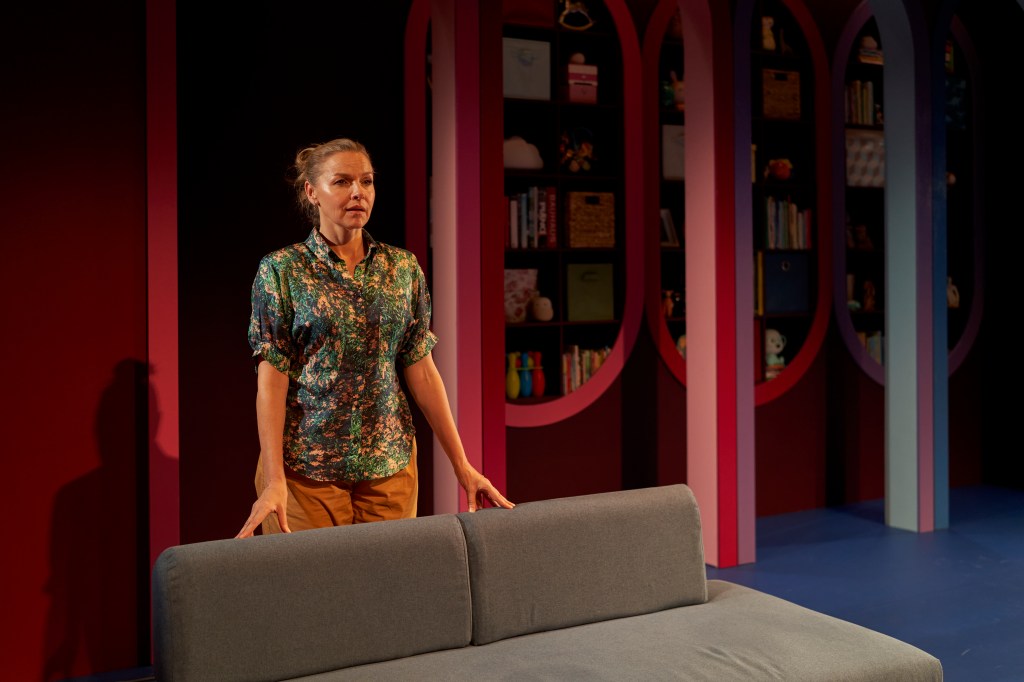
Hayley McElhinney is Lucy’s chaperone Charlotte, initially judgemental and disapproving, yet she ironically declares, “I, myself, never complain”. Even digs and gibes are delivered with a courteous bob and a polite social gesture. McElhinney’s precise pacing heightens both the irony and humour. She has only good intentions for Lucy, trying to guide her towards the right choices.
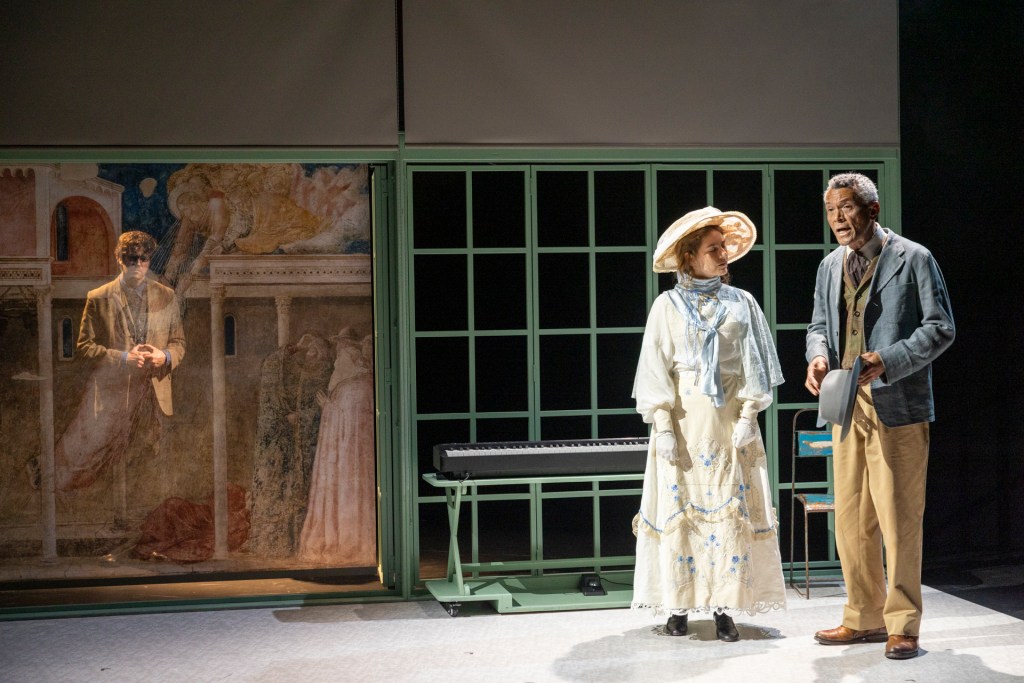
Patrick Williams is Mr Emerson, George’s father, whose kindness and genuine nature provide a contrast to the prohibitive society, encouraging Lucy to “abandon your false dignity” and to think freely, a theme that pervades the play.
Charles Wu is Cecil Vyse, an awkward man who thinks himself superior to all others. However, Wu evokes warmth and creates a likeable character. Tom Conroy is the roguish Reverend Mr Beebe, while Tomas Kantor is Lucy’s unruly brother Freddy. Kate Atkinson takes on the roles of Miss Lavish and Mrs Honeychurch.
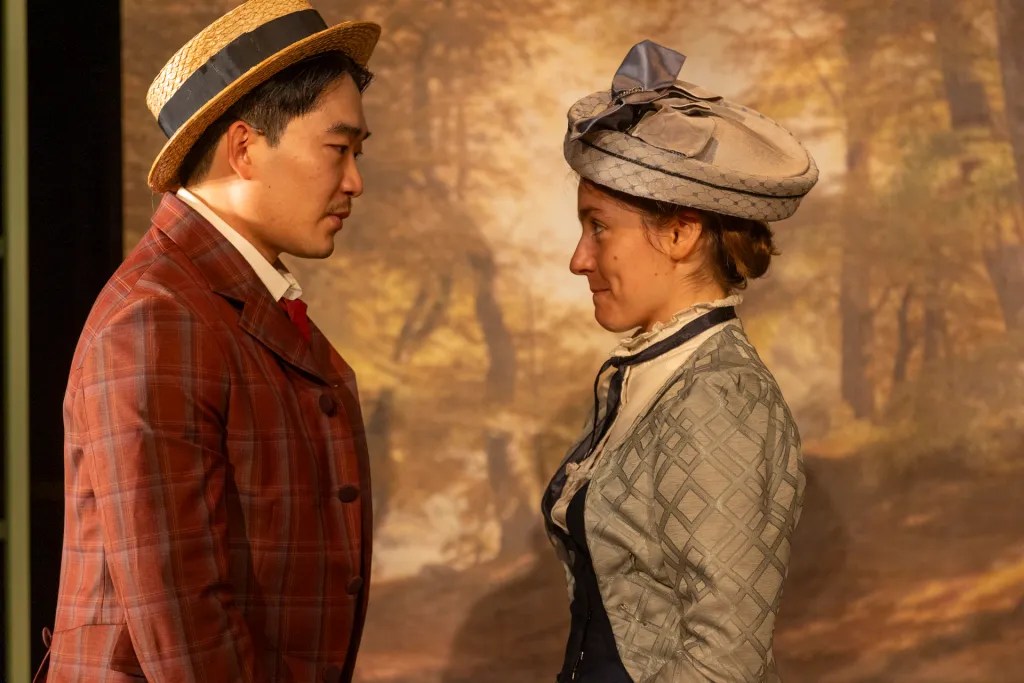
All the costumes were made from old clothing and reworked fabrics and in a nod to the constraints of the time, Zoe Atkinson creates clothing for the characters, with costumes particularly restrictive for the women.
The story is set between Italy and England, with the two locations providing a striking contrast. Italy is passionate and love is shared openly, while England is restrained and governed by social expectations. Hailley Hunt’s set could have emphasised this difference more; instead, the backdrop and staging remain the same throughout. A simple series of frames opens and closes to create windows and doorways, while during the scenes in Italy a window space is adorned with a picture of Florence.
However, the simplicity of the staging puts the focus on the characters and the narrative and some of the simplest scenes are the most enjoyable. One is a humourous and clever scene told in Italian, translated with words on slides in the background.
Madeleine Picard uses music and metronome beats to signify movement and space during a joyful tennis game with an imaginary ball. Elle Evangelista’s choreography is beautifully executed here and again during the water scene, with the men bobbing, prancing and playing together. In collaboration with Amelia Lever-Davidson, the soft lighting and slow motion movement, combined with the men’s breath-holding and underwater facial expressions, give the scene a sense of tenderness.
Composer Grace Ferguson explains: “We see Lucy’s view through music and wanted to capture the liminal space between self, instrument and imagination.” Music is used cheerily throughout the production with various characters playing the piano, including an especially lively performance by Lucy.
Sexual awakening is another key theme in this play, explored through Lucy and George’s relationship, but also through other characters. This play comes with a full nudity warning – and we do mean full, as the program states. The nudity is splendidly integrated into the play. It’s frolicking good fun that has the audience rolling with laughter.
For all of Lucy’s resisting, the answer seems obvious to the audience – love should win – but is it ever really that simple? Chapple finishes, “It’s a journey everyone has to go on figuring out how to live honestly in this world and be true to the person you are and how much that can cost.”
With romance, plenty of humour and a thought-provoking script, A Room with a View makes for a delightful night at the theatre.
4 stars
Presented by Belvoir St Theatre A Room with a View is playing at the Upstairs Theatre, Belvoir St Theatre in Surry Hills Sydney until 1 November 2026.
Run Time: 2 hours 40 minutes (including a 20 minute interval)
For tickets visit Belvoir St Theatre Book Now



Leave a comment